
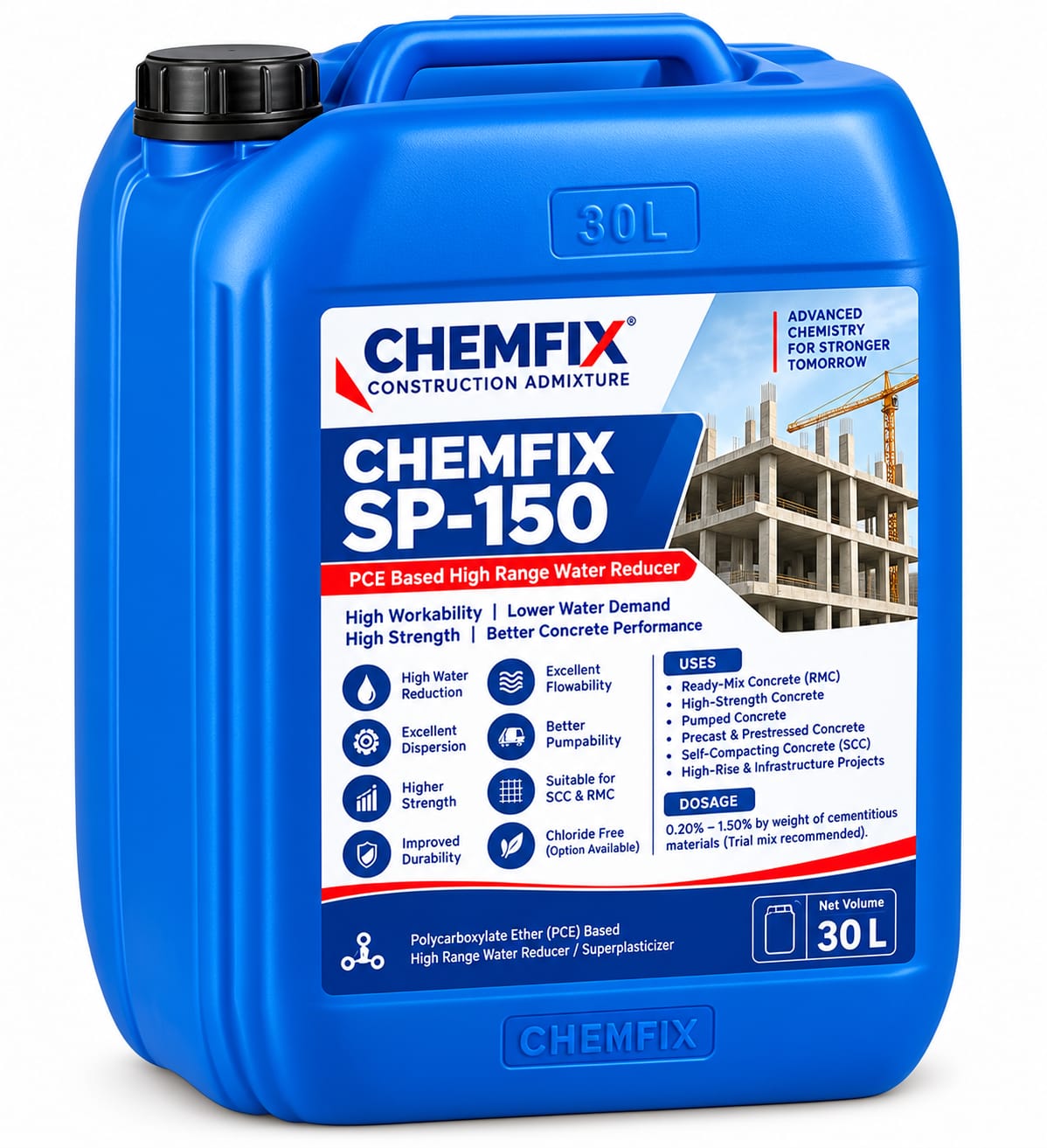
CHEMFIX SP-150
polycarboxylate Ether (PCE) Based High Range Water Reducer / Superplasticizer
CHEMFIX SP-150 is a high-performance Polycarboxylate Ether (PCE) based High Range Water Reducing Admixture (Superplasticizer) specially designed to produce highly workable, flowable and high-strength concrete with significantly reduced mixing water.
Its advanced PCE technology disperses cement particles efficiently, allowing concrete to achieve high workability at a lower water-to-cement ratio. This helps improve compressive strength, durability, density, surface finish and resistance to water penetration.
CHEMFIX SP-150 is suitable for ready-mix concrete, high-strength concrete, pumped concrete, precast concrete and heavily reinforced structural elements where high workability and reduced water content are required.
—
Uses
CHEMFIX SP-150 is recommended for:
– High-strength concrete
– High-performance concrete
– Pumped concrete
– Precast and prestressed concrete
– Self-Compacting Concrete (SCC)
– Concrete with congested reinforcement
– High-rise building construction
– Raft and foundation concrete
– Columns, beams and slabs
– Bridge and infrastructure concrete
– Concrete requiring high flowability
– Concrete requiring reduced water-cement ratio
– Concrete containing supplementary cementitious materials such as fly ash, GGBS or silica fume
PCE-based superplasticizers are particularly useful where high flowability must be achieved without simply increasing mixing water.
—
Benefits & Advantages
1. High Water Reduction
CHEMFIX SP-150 can significantly reduce the amount of mixing water required while maintaining the desired concrete workability. Actual water reduction depends on cement type, mix design, materials, dosage and site conditions.
2. Higher Compressive Strength
Reduced water content can help produce a lower water-cement ratio, contributing to higher early and ultimate compressive strength.
3. Excellent Workability
Provides high flowability and improved concrete placement without unnecessarily increasing the water content.
4. Improved Pumpability
Helps produce cohesive and workable concrete suitable for pumping, including applications with long pumping distances and congested reinforcement.
5. Better Surface Finish
Improved cement dispersion and concrete flow can contribute to a denser and smoother finished surface.
6. Reduced Bleeding & Segregation
When the dosage is properly optimized, the admixture can help maintain a cohesive concrete matrix and reduce unwanted bleeding and segregation.
7. Improved Durability
Lower water-cement ratios generally produce denser concrete with lower permeability, which can contribute to improved long-term durability.
8. Suitable for High-Performance Concrete
Its PCE chemistry makes it suitable for high-strength, high-performance and flowable concrete applications.
—
Recommended Dosage
Recommended dosage: 0.20%–1.50% by weight of cementitious materials.
The optimum dosage should always be established through laboratory and field trial mixes because performance depends on:
– Cement type and chemistry
– Cementitious material content
– Aggregate characteristics
– Water quality
– Mix temperature
– Initial slump requirement
– Required slump retention
– Supplementary cementitious materials
– Concrete transportation time
– Placement method
Do not determine final dosage solely from the recommended range. A trial mix is recommended before commercial application.
PCE admixture manufacturers commonly establish dosage through trial mixes because concrete materials and site conditions can significantly affect performance.
—
Application Method
CHEMFIX SP-150 is supplied as a ready-to-use liquid admixture.
Recommended Procedure
1. Prepare the concrete mix according to the approved mix design.
2. Add approximately 70–90% of the required mixing water and mix the concrete adequately.
3. Add CHEMFIX SP-150 preferably after the initial mixing water has been incorporated.
4. Continue mixing until uniform dispersion is achieved.
5. Adjust the remaining mixing water only according to the approved mix design and required workability.
6. Check slump/slump flow before placing the concrete.
Important: Avoid adding extra water at site merely to increase slump. If additional workability is required, dosage adjustment should be evaluated through a controlled trial.
Some PCE admixture technical data sheets also recommend addition after most of the mixing water has been incorporated to obtain effective dispersion.
—
Packaging Size
CHEMFIX SP-150 can be supplied in packaging suitable for construction-site and project applications.
Available Packaging Options:
– 5 kg
– 20 kg
– 30 kg
– 220 kg Drum
Note: Actual packaging sizes should be confirmed according to the current CHEMFIX product range and customer/project requirements.
—
Compatibility
CHEMFIX SP-150 is intended for use with commonly used Portland cement and blended cement systems.
Compatibility should be verified when used with:
– Fly ash
– GGBS
– Silica fume
– Other supplementary cementitious materials
– Accelerating admixtures
– Retarding admixtures
– Air-entraining admixtures
– Other chemical admixtures
Trial testing is recommended when combining CHEMFIX SP-150 with other admixtures.
—
Precautions
– Use appropriate gloves, protective clothing and eye protection during handling.
– Avoid prolonged contact with skin and eyes.
– Do not mix directly with dry cement.
– Do not dilute unless specifically instructed by CHEMFIX technical personnel.
– Do not exceed the recommended dosage without trial testing.
– Overdosing may cause excessive slump, delayed setting or other undesirable effects depending on the concrete mix.
– Do not add uncontrolled water to compensate for loss of workability.
– Always conduct a trial mix before large-scale application.
—
Storage
– Store in the original, tightly closed container.
– Keep in a cool and dry place.
– Protect from direct sunlight.
– Protect from extreme temperatures and freezing.
– Do not allow contamination by cement, dust, water or other chemicals.
– Stir/agitate gently if required before use after prolonged storage.
– Follow the product TDS/SDS for specific storage temperature and shelf-life requirements.
—